
The short answer
Your garage door is almost certainly the weakest point in your home's exterior walls, and the wind events that roll through Jefferson County with fall cold fronts can expose that weakness fast. A door that buckles or blows in doesn't just damage itself—it lets wind pressure into the garage, which can push up on the roof structure from underneath and cause much bigger problems. The fix isn't complicated: inspect the hardware, address anything loose or worn, and know when a reinforcement or replacement makes more sense than another repair.
Why a garage door fails before the rest of the house does
Exterior walls are solid, braced, and tied into the frame at multiple points. A garage door is a large panel of moving material held in place by tracks, rollers, hinges, and a spring system—none of which were designed to resist a sudden gust the way a stud wall is. When wind pushes against a closed door, that force is spread across rollers and tracks that can bend, pull loose, or pop out of alignment under enough pressure. Once one panel buckles, the door loses its shape entirely and can fail in seconds. This is true of almost any garage door, but it matters more here because of how this area's weather actually behaves.
What fall actually brings to this part of Missouri
Spring gets the reputation for tornadoes, but autumn in Jefferson County has its own pattern worth planning for: strong cold fronts move through quickly, often bringing a line of storms with sudden straight-line wind gusts rather than the sustained severe weather of spring. These events can arrive with little warning between otherwise mild, humid afternoons. A door that's been fine all summer can suddenly be tested by a 50-60 mph gust on a random Tuesday evening. This is also the window before winter ice and salt start working on hardware, so it's a practical time to catch problems while they're still easy to reach and fix.
Warning signs your door won't hold up
- Rollers that are worn, cracked, or rattling in the track instead of rolling smoothly.
- Visible gaps or play in the track, especially where it bolts to the wall studs.
- Dents or bowing in the panels, which weaken the door's ability to flex and recover under pressure.
- Cracked or missing weatherstripping along the bottom and sides, which lets wind and water find a way in even before a panel gives way.
- An opener that strains or reverses unexpectedly, which often means the door is out of balance and already under more stress than it should be.
Steps to take before the next wind advisory
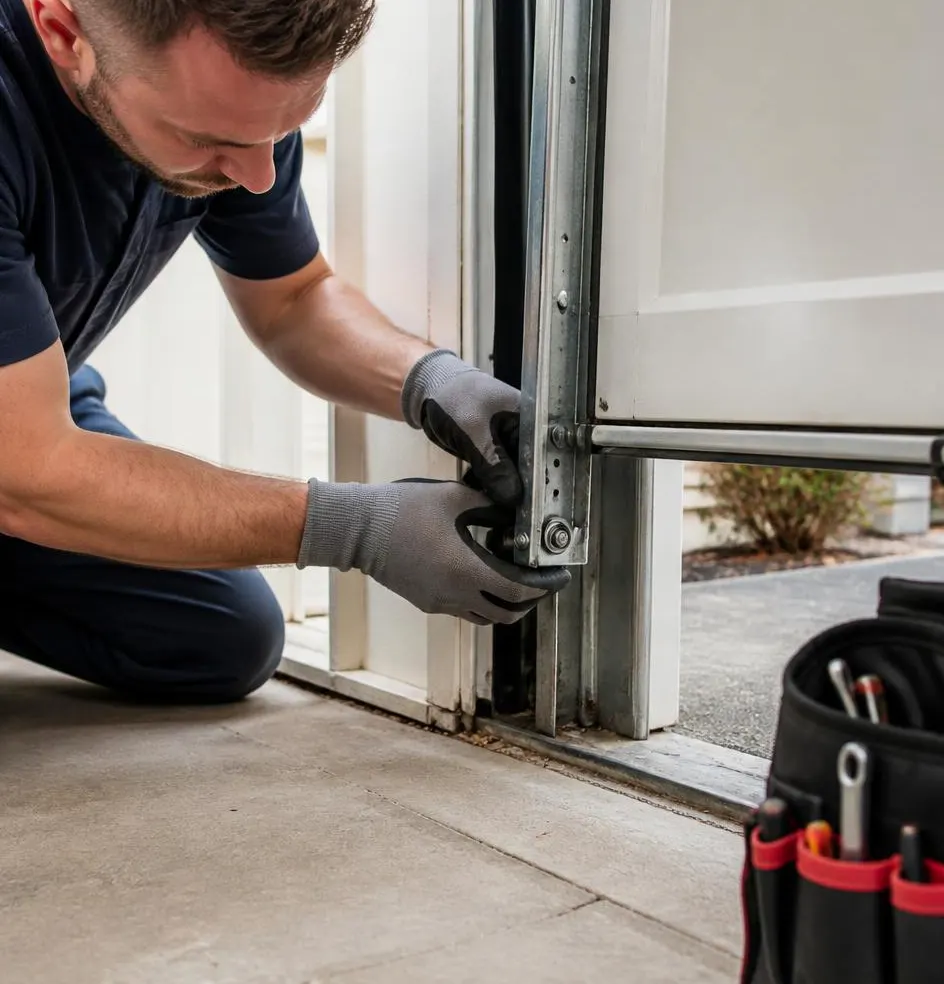
- Check and tighten all hardware. Track brackets, hinges, and roller bolts work loose over a season of use; a wrench and twenty minutes catches most of this.
- Test the balance. Disconnect the opener and lift the door halfway by hand—it should stay in place. If it drops or shoots up, the springs are off, and that imbalance makes the whole door less stable in wind.
- Inspect the tracks for bends or gaps at the wall connection, since this is where wind load concentrates.
- Replace cracked weatherstripping to cut down on wind infiltration even on a door that's otherwise sound.
- Consider a retrofit bracing kit for an older door. These horizontal struts bolt across the panels and add real rigidity for a fraction of what a full replacement costs—typically a few hundred dollars installed, compared to $1,000-$3,000+ for a new wind-rated door, as a general national range.
Repair, reinforce, or replace?
A bracing kit is a reasonable middle step for a door that's structurally fine but aging. It won't help a door that's already warped, has a bent track, or has panels that no longer sit flush—at that point you're reinforcing a problem rather than solving it. If the door is more than 15-20 years old or has been patched more than once, replacement with a wind-rated door is usually the more durable option, especially for anyone who's had a panel fail in a past storm.
After a storm hits
If the door took a hard gust, don't run the opener before checking it. A bent track or bowed panel under power can jump the track entirely or snap a cable. Look for visible damage, listen for grinding, and if the door is off-balance or won't close evenly, leave it as-is until it's inspected.
When to call High Ridge Garage Door
If your door is out of balance, the track shows play at the wall, or you're hearing new noises before a storm rolls through, that's the time to call rather than wait. High Ridge Garage Door can handle spring replacement to fix balance issues, perform garage door maintenance to catch worn rollers and hardware before they fail, and respond with emergency garage door service if a storm has already done damage and you need the door secured or repaired quickly.
If you're in High Ridge, Fenton, House Springs, or anywhere else in Jefferson County and want your garage door checked before the next high wind advisory, call High Ridge Garage Door today.